Etna eruption — Catania airport, volcanic ash and your Sicily trip
What is happening on Etna in 2026
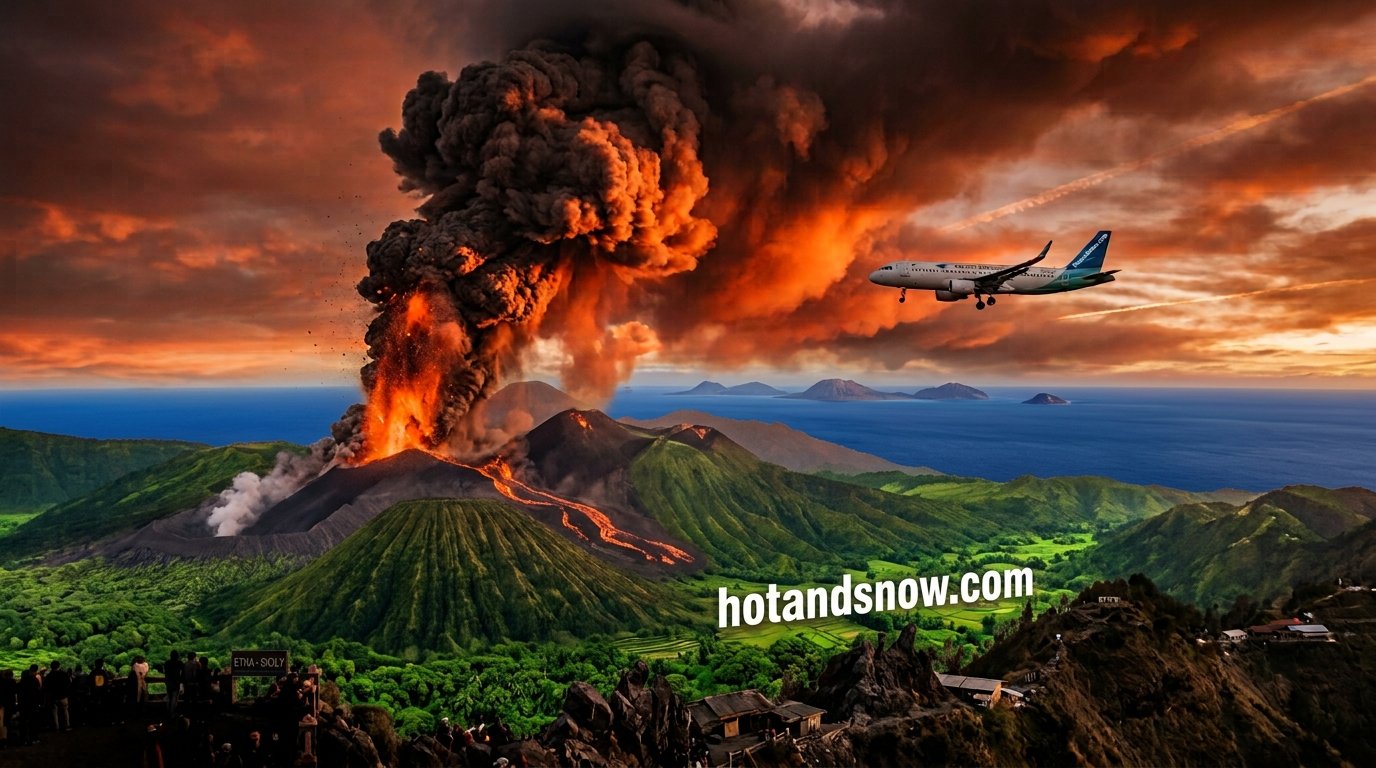
In summer 2026 Etna went through a series of eruptive episodes: lava fountains, Strombolian explosions and ash columns. Activity peaked on 6–7 August, when a violent paroxysm at the Voragine crater turned into a flank eruption with new vents at around 2,700–2,750 m.
In September the volcano emitted ash again. On 14 and 15 September the airport operator SAC closed airspace sectors C1 and B3, and arrivals and departures at Catania were suspended for many hours. Some aircraft were diverted to Palermo, Trapani and Comiso.
Fire map — Italy
Each dot is a thermal anomaly detected from orbit. Tap a dot for radiative power and the satellite pass time.
Updated —
Satellites pass over a given point a few times a day, so a fire may appear with a delay. Use this to assess the situation — it does not replace official bulletins from national civil protection. Source: NASA FIRMS.
Hotspot statistics — Italy
How Catania airport closures work
Closures are not triggered by the eruption itself but by ash in the air and the wind direction at flight level. The INGV institute issues a colour-coded aviation notice: green, yellow, orange and red. With a red code and winds carrying ash over Fontanarossa, specific airspace sectors are closed and airport traffic stops with them.
A closure usually lasts from a few hours to a day and is extended in updates every few hours. Before heading to the airport, check your flight with the airline and the airport website — not with volcano photos on social media.
Related articles
- Italy Campi Flegrei — earthquakes near Naples and bradyseism explained Campi Flegrei is a caldera west of Naples where the ground has been slowly rising for years and
-
 Italy
Heatwave in Rome: what to expect and how to stay safe
A heatwave is not simply a hot day. Meteorologically it is a stretch of at least three consecut
Italy
Heatwave in Rome: what to expect and how to stay safe
A heatwave is not simply a hot day. Meteorologically it is a stretch of at least three consecut
-
.png) Italy
Storms in the Italian Alps — why they arrive so suddenly
An Alpine storm rarely announces itself with a morning glance at the sky. At eight it can be cl
Italy
Storms in the Italian Alps — why they arrive so suddenly
An Alpine storm rarely announces itself with a morning glance at the sky. At eight it can be cl
-
 Italy
Hail during Alpine storms — how often it falls and why it is dangerous
Hail is the part of an Alpine storm that catches people out most often. Lightning is expected,
Italy
Hail during Alpine storms — how often it falls and why it is dangerous
Hail is the part of an Alpine storm that catches people out most often. Lightning is expected,
-
.png) Italy
🌋 Sicily Wildfires – Live Map, Current Situation and Tourist Safety
Sicily wildfires today, Sicily has become one of the Mediterranean’s most wildfire‑prone region
Italy
🌋 Sicily Wildfires – Live Map, Current Situation and Tourist Safety
Sicily wildfires today, Sicily has become one of the Mediterranean’s most wildfire‑prone region
-
inne-zagrozenia Volcanic ash and flights — cancellations and your passenger rights
Volcanic ash destroys jet engines, so airspace is closed without debate when an ash cloud is ar
Is the eruption dangerous for tourists
Lava flows through uninhabited parts of the slope, most often towards the Valle del Bove, and does not threaten coastal towns. The real nuisance is falling ash: slippery roads, dirty cars and irritated eyes and airways. During ashfall, towns may impose speed limits and ban motorbikes.
Summit excursions are restricted during eruptions — closed zones apply and routes are allowed only with a licensed guide. Never cross the barriers: volcanic bombs and sudden blasts come without warning. The live map for Italy shows thermal hotspots — satellites pick up flowing lava as well as fires.
Wind and weather — Italy
Wind direction and speed decide which way a fire runs. Switch the layer to temperature or humidity to judge the risk.
Strong wind, temperatures above 35 °C and humidity below 30% together are the conditions in which fire spreads fastest.
If your flight is cancelled
An eruption counts as an extraordinary circumstance, so fixed EU compensation usually does not apply. You still have the right to a refund or re-routing and to care: meals and accommodation while you wait. See our guide on volcanic ash and cancelled flights, and all volcano topics in other hazards.